





























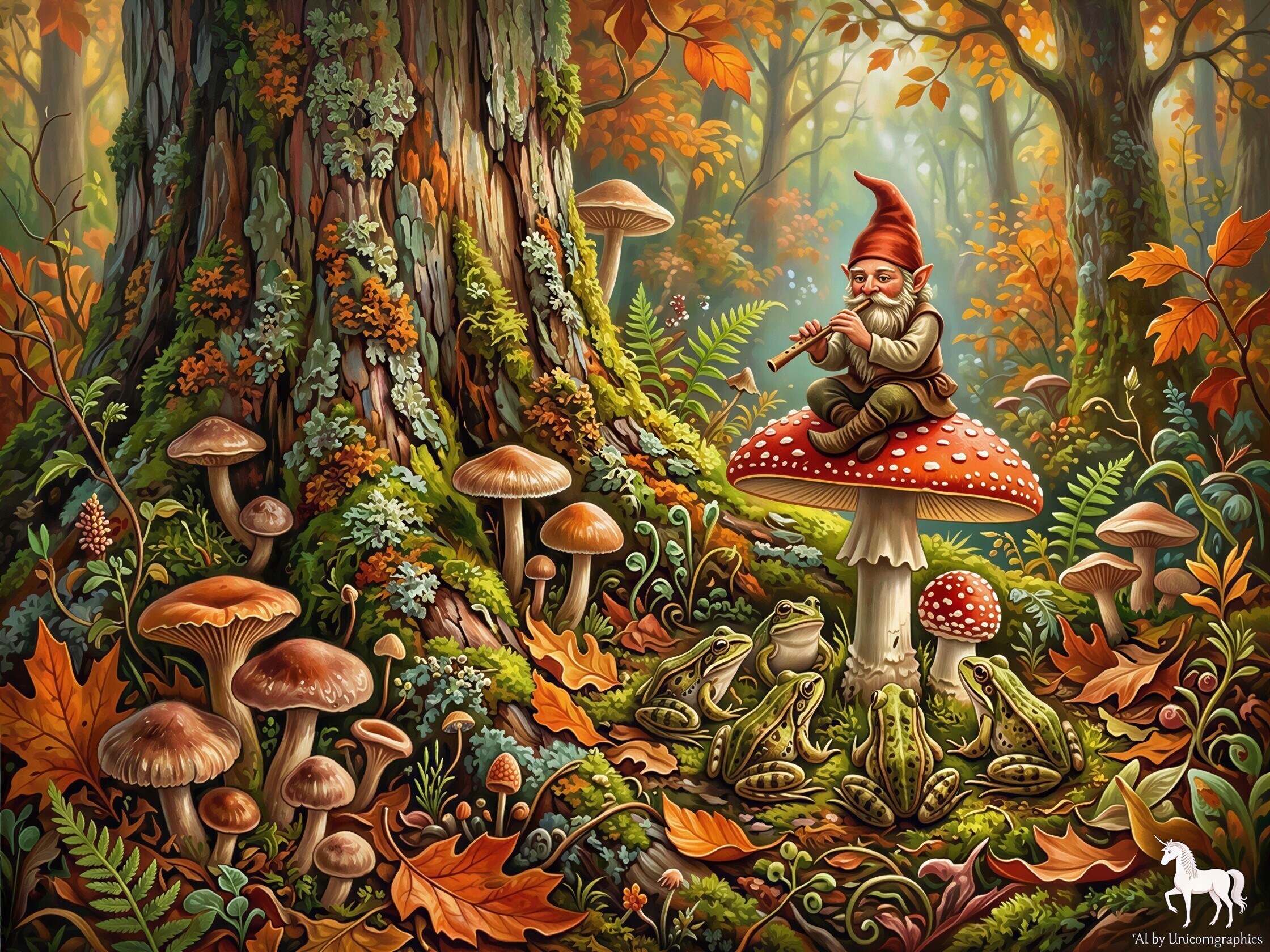
The Piper on the Red Mushroom by miwi
Close
Hover over top left image to zoom.
Click anywhere to exit.
Members remain the original copyright holder in all their materials here at Renderosity. Use of any of their material inconsistent with the terms and conditions set forth is prohibited and is considered an infringement of the copyrights of the respective holders unless specially stated otherwise.

DDG
Image For the Story
Description
In the heart of the Greenwood, where the sun dripped through the leaves like liquid gold, there stood an ancient oak so wide that twenty men with linked hands could not encircle it. Moss and lichen clothed its bark in shades of emerald and silver, and at its feet grew a kingdom of mushrooms: copper brown caps, slender ivory stalks, and, in the very center, a single scarlet toadstool freckled with white. Upon this red capped throne sat a gnome no taller than a milk jug. His hat, pointed and crimson, leaned slightly to the left as though listening to secrets in the wind. His beard was as soft and gray as the smoke of a winter chimney, and his eyes sparkled with the mischievous wisdom of many long years. His name was Thimblewick, though few in the forest were bold enough to call him anything at all. For Thimblewick was the Piper of the Greenwood, keeper of the songs that stitched the forest together. It was said that when he played his reed flute, roots woke from their slumber and stretched deeper into the earth, and every leaf remembered its color. On one crisp autumn evening, when the forest smelled of wet soil and falling leaves, Thimblewick climbed onto his mushroom throne, cleared his tiny throat, and raised his flute. Around him, the air grew still. Ferns leaned closer. Dewdrops perched at the edge of their blades, quivering with anticipation. From the damp shadows at the base of the oak, a circle of frogs hopped into the fading light. There were seven of them, green as polished jade, each with a different pattern of black spots upon its back, as if painted by a patient hand. They formed a ring around the mushroom and sat back on their haunches, their wide mouths curved in permanent astonishment. “You are late, Croaksworth,” Thimblewick said, pointing the flute at the plumpest frog. Croaksworth puffed out his throat indignantly. “The stream ran backward again. Took me a while to find the right direction.” “Streams hardly ever run backward,” Thimblewick replied, though his eyes twinkled. “Unless they are sulking. Did you forget to greet it this morning?” The other frogs chuckled in their bubbling way, and Croaksworth muttered something about busy schedules and inattentive dragonflies. Thimblewick seated himself cross legged on the toadstool. All around, the forest blazed with color—copper leaves, amber ferns, and the deep velvet green of moss. High above, a small gap in the branches framed a patch of evening sky, pale and expectant. The first stars had not yet appeared; the world was holding its breath. “It is the Night of Listening,” Thimblewick announced. “The border between what is and what might be grows thin as a spider’s thread. Every creature must remember its proper name, or risk being blown away like a dry leaf.” The frogs shifted uneasily. Proper names were serious business. “Tonight,” the gnome went on, “we will play the Remembering Song. You must echo every note. If you croak it true, your names will shine brighter than ever. If you miss even one, the forest will grow confused, and so will you.” “Can a frog forget it is a frog?” whispered the smallest of them, Tadpole Tom, who had only just grown his legs. Thimblewick looked at him kindly. “Anything can be forgotten if it is not sung about,” he said. “So let us sing.” He lifted the flute to his lips. The first note slipped out as soft as a sigh, twining around the oak and through the spiraling mushrooms like a silver thread. The frogs drew breath, ready to answer. And far away, beneath a distant hill where roots curled like sleeping dragons, something old and troubled stirred at the sound. The song began as a simple melody, no more than three notes gently rising and falling like a cradle on a breeze. The frogs croaked in reply, shy at first, then louder, their voices rough but earnest. The Remembering Song wound through the undergrowth, brushed past the ferns, and slipped into hollows no sunlight ever reached. Deep under the ancient oak, where the soil turned to cool stone, the melody arrived as a distant trembling. It rolled past sleeping worms and startled beetles, and finally reached a forgotten chamber tangled in roots as thick as a giant’s arm. There, in the center, lay a shape of shadow, curled in upon itself like a question no one dared to ask. The shadow shivered. Above, Thimblewick changed the tune. The notes climbed higher, weaving in and out like swallows at dusk. The frogs did their best to follow, but their throats wobbled on the trickier turns. Croaksworth missed a leap and coughed, trying to pretend it was intentional. Tadpole Tom, though, leaped bravely from note to note, his small voice clear and bright. “Better,” murmured Thimblewick between phrases. “Remember, every sound is a thread. Tie it tightly.” Below, the shadow unfurled. It was not entirely darkness; there was something like bark and something like stone, yet neither one nor the other. It had once been the Heart Root, the first root of the first tree, back when the world was new and everything knew exactly what it was. But long ages of silence had thinned its memory. It had forgotten its true name and dreamed uneasy, nameless dreams. Tonight, the song was tugging at it. The Heart Root stirred, and the oak shuddered from crown to roots. A rain of leaves came tumbling down around Thimblewick’s mushroom throne. The frogs ducked under their own legs in alarm. “That was not in the music,” Croaksworth croaked. Thimblewick lowered his flute. The forest had fallen very quiet, save for a faint, deep creaking, like a door in the cellar of the world slowly opening. “The name is waking,” he said softly. “What name?” asked Tadpole Tom. “The oak’s first name,” replied the gnome. “The one it had when forests were newly born. I did not mean to call it, not yet.” From beneath the earth came a low, groaning whisper, not in words but in feeling: a question, lonely and enormous. Every creature in the clearing heard it, not with their ears but in the hollow behind their ribs. “Who… am… I?” Tadpole Tom’s eyes grew round. “It’s lost!” “Yes,” said Thimblewick. “And a tree that forgets its name may let go of its leaves, its branches, and finally its roots. The forest could unravel.” He hopped from the red mushroom and placed a tiny hand on the rough bark of the oak. “We must finish the Remembering Song, but this time we will sing not for ourselves, but for the Heart Root.” “But we are only frogs,” whispered Croaksworth. “Our notes are muddy.” “Mud grows lilies,” answered the gnome. “Sing with all the truth you have, and that will be enough.” He raised his flute again. This time the music flowed low and steady, like water under ice. Thimblewick wove into it everything he knew of the oak: the coolness of its shade, the strength of its trunk, the stories its leaves had overheard. The frogs echoed him, their rough voices full of sincerity. Little by little, the groaning beneath the soil softened. The nameless question quivered, then began to shape itself into something firmer. From the deepest dark rose a single, clear tone, older than language. It joined the song like a long lost harmony. The oak straightened. Its leaves, which had been ready to fall, brightened with renewed color. Mushrooms at its roots flushed with golden light. The frogs felt their own names settle warm and solid in their chests: Croaksworth, Lily Leap, Bogbell, Tadpole Tom, and the rest. The music faded into the evening. Thimblewick leaned his back against the vast trunk, breathing hard but smiling. “Now the oak remembers,” he said. “And as long as someone, somewhere, is willing to sing, nothing in this forest will ever be truly lost.” The frogs sat quietly, listening as the newly steadfast roots hummed a deep, contented note beneath them. High above, the first star appeared, and another, until the sky itself seemed to be singing back. And so, every autumn on the Night of Listening, if you walk softly beneath the old trees and keep your heart very still, you may hear a distant flute and a chorus of earnest frogs, mending the world with their song, one remembered name at a time.


Comments (3)
welcome back,delightful tale and eye catching illustration.
Magic !
Fantastic fantasy image.