

































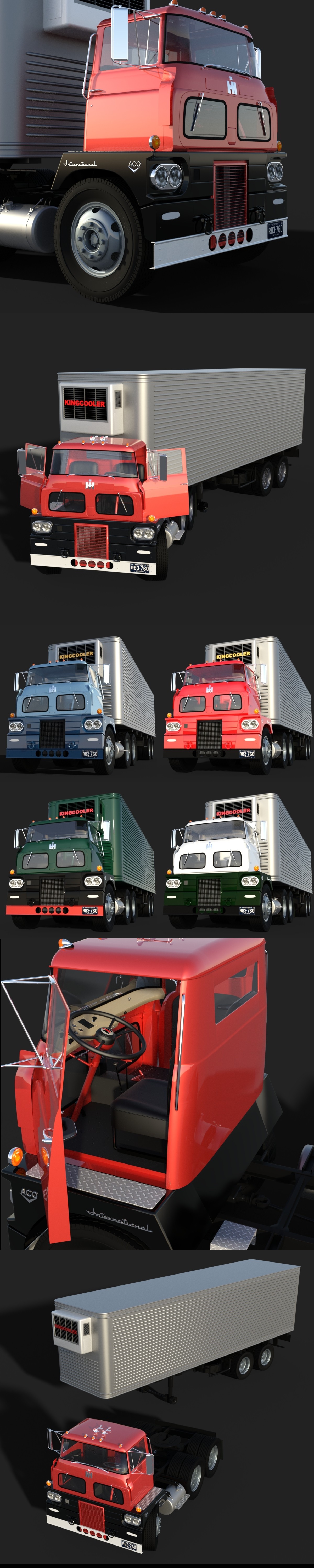
INTERNATIONAL SIGHTLINER by 3DClassics123456
Close
Hover over top left image to zoom.
Click anywhere to exit.
Members remain the original copyright holder in all their materials here at Renderosity. Use of any of their material inconsistent with the terms and conditions set forth is prohibited and is considered an infringement of the copyrights of the respective holders unless specially stated otherwise.
No AI - This artwork was created entirely by hand or with traditional digital tools.
Description
Thank you for your kind comments about my previous models.
Another 3D model. This one was asked by a customer.
For decades, cab-over-engine trucks and tractors were often created in a straightforward way: the manufacturer simply took a conventional truck cab minus the nose and front doghouse and moved it up and forward, perching it atop the engine room. This produced a fully functional cabover truck to improve maneuverability and meet highway regulations for total vehicle length—even if the appearance was a little peculiar. International Harvester refined that configuration, if you will, with the 1957 Sightliner.
For the Sightliner, International took the very same approach, borrowing the cab and doors from its conventional medium and heavy trucks to create a tilt-cab COE. Minus the optional sleeper unit, the total cab length was a compact 48 inches. But instead of an awkward-looking plain, flat closeout panel at the front of the cab, I-H designers came up with an innovation: a pair of large windows of laminated safety glass at the driver’s ankle height. The objective, of course, was to improve forward visibility, especially at street level, and an auxiliary pair of windscreen wipers was thoughtfully provided.
Officially known as the ACO (two-axle) and ACOF (three-axle) series, the Sightliner could be fitted out in most any conceivable configuration, like any commercial chassis-cab combination. There were straight trucks and semi-tractors, usually with gasoline or LPG power, for nearly any purpose, from mobile home toters to concrete transit mixers.
What a great idea—except that drivers didn’t care for it at all. Nicknames for the Sightliner cabs included “greenhouse” and “fishbowl.” Operators were known to block off the windows with cardboard or sheet metal inside the cab or to paint them over.
The sightliner’s a cool concept, but was unpopular for numerous reasons. In hot weather, the driver got sunburned legs. In cold weather, the driver got cold legs from the windows. Safety was probably the main reason for the design’s unpopularity, as well as the overall general decline of the cabover.
The lower windows were susceptible to rocks thrown up by other cars, and thieves would smash them to reach in and grab whatever was in the cab.
Pedestrians were looking right at your crotch if your fly was open or you were doing a little scratchin’(hey, truckers gotta itch sometimes).
Also, when you pulled up behind a car the glare would send a laser beam right into the car driver’s eyes. Oncoming cars’ headlights would shine into the cab.
They were hard to get into.
Add that to the other issues that killed the cabover- hard to maintain, and increasing allowable lengths on the US highway system- and this neat idea was doomed.
The Sightliner was discontinued by 1964, replaced by the CO cabover series.


Comments (5)
Joli travail. C'est sûr que ces deux petits pare-brises ont des inconvénients (je me rappelle l'image de Gaius). Mais ça serait mignon avec des rideaux en dentelle.
Belle bête!
Cool lookin' can be far from functional.
Excellent work my friend 👍🙋♂️
J'ai entendu dire que des cache-sexes étaient proposés en supplément ! Le camion n'était pas très sexy mais ton modèle est parfait.